Manual Food Logging vs. Photo Tracking: Pros and Cons
August 25, 2026
If you've tried to track what you eat for more than a week, you've probably hit the same wall: the method you started with stopped matching how you actually eat. Manual logging and photo tracking solve different problems, and neither one is objectively "better" — they just fail in different places. Here's the honest breakdown.
Manual logging: typing it in yourself
This is the classic approach — searching a food database, weighing portions, logging every ingredient. Apps like MyFitnessPal built an entire category around it.
Pros:
- Precision, if you're willing to work for it. Weighing food on a kitchen scale and logging exact grams is still the most accurate way to know what you ate. No estimation involved.
- You learn the numbers. After a few weeks of manual entry, you start memorizing calorie counts for your regular meals. That knowledge sticks even if you stop logging.
- Works for anything. A homemade curry with twelve ingredients, a protein shake, a restaurant dish you can look up — manual entry doesn't care how visually complex the food is.
- No dependency on lighting, angles, or a decent camera. You can log from memory, before you eat, after you eat, or from a menu.
Cons:
- It's slow, and slow things get skipped. Searching a database, comparing near-identical entries, adjusting portion sizes — it adds up to real time, several times a day, forever.
- Database quality is a lottery. User-submitted entries are often wrong. "Chicken breast, grilled" might have five versions with different calorie counts, and you have no way to know which one is right.
- It's the first habit to die under stress. Busy day, bad mood, eating out with friends — manual logging is usually the first thing people abandon, and once the streak breaks, a lot of people don't restart.
- Portion estimation is still a guess for most people, scale or not. Most of us don't actually weigh our food most of the time, so "manual" often just means eyeballing grams instead of eyeballing a photo.
Photo tracking: point your phone and go
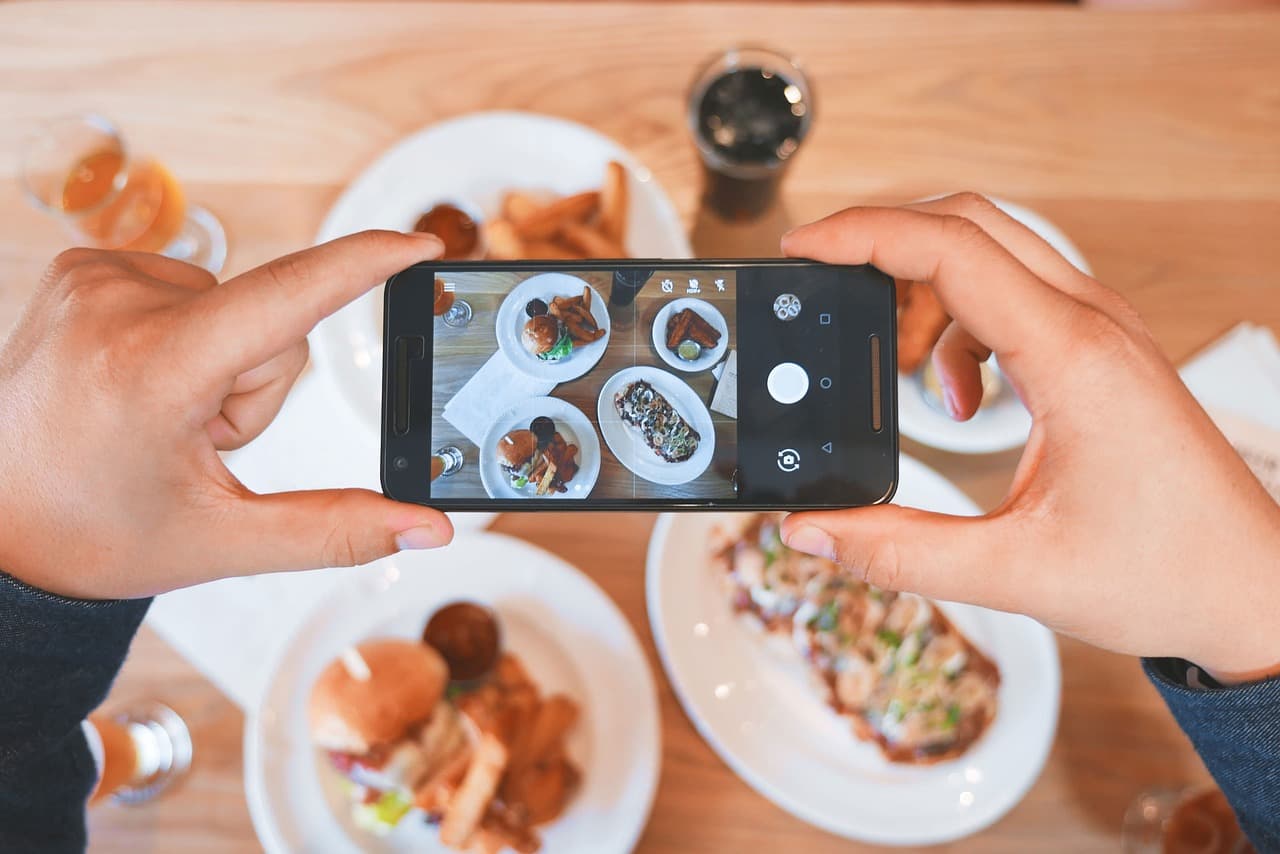
This is the newer approach — take a picture of your meal and let AI estimate what's in it. Calerio works this way, along with a handful of other apps.
Pros:
- Speed is the whole point. A photo takes seconds. For people who quit logging because it felt like a chore, this is usually the difference between tracking for two weeks and tracking for two years.
- Lower barrier when you're eating something unfamiliar. A restaurant plate, a friend's home cooking, a dish you don't know the name of — you don't need to identify or search for anything.
- You get a visual food diary for free. Scrolling back through photos of what you ate is a genuinely useful way to notice patterns that a list of numbers doesn't show as clearly.
- Good tools let you correct the estimate, so you're not just trusting a black box — you're using AI as a fast first draft, not a final answer.
Cons:
- It's an estimate, not a measurement. AI is guessing volume and density from pixels. Hidden ingredients — oil, butter, sauce, dressing — are notoriously easy to underestimate because you often can't see them.
- Mixed or stacked food confuses it. A casserole, a smoothie, a layered burrito bowl — anything where ingredients are blended or hidden is harder to estimate accurately than a plate with clearly separated items.
- Lighting and angle matter more than they should. A dim photo or an awkward angle can throw off portion estimates in ways a careful manual entry never would.
- It can create false confidence. A precise-looking number next to a photo feels authoritative even when it's a rough estimate, and it's easy to stop questioning it.
Where each one actually breaks down
Manual logging breaks down on busy days, unfamiliar foods, and long streaks — it demands a level of discipline that most people can sustain for weeks, not months. Photo tracking breaks down on accuracy for tricky foods and on the temptation to trust a number without checking it. Neither one fails randomly; they fail exactly where their core trade-off catches up with you.
The accuracy-versus-effort trade-off is really the whole story. Manual logging trades your time for precision. Photo tracking trades some precision for your time back. Which one is worth more to you probably depends on whether you've ever actually kept a manual log going for more than a month.
The honest answer: most people end up hybrid
In practice, the best approach usually isn't picking one method — it's matching the method to the meal. A packaged snack with a barcode takes two seconds to scan and is more accurate than either photo or manual entry. A homemade dinner you cooked yourself might be worth a quick manual entry since you already know the ingredients. A restaurant meal or something you didn't make is where a photo genuinely saves you from either giving up or guessing badly.
This is why tools that combine methods tend to hold up better over time than ones that force a single approach. Calerio, for example, leans on photo logging as the default — snap a plate, get calories and macros in seconds — but also supports barcode scans, voice notes, and manual text entry for the cases where a photo isn't the fastest or most accurate option. You can also edit any AI estimate by hand, which matters more than people expect: the fastest path to bad data is trusting an estimate you never bothered to check.
The real question isn't "which method is more accurate" in the abstract. It's which method you'll actually still be using in eight weeks. A slightly-less-precise log you keep every day beats a perfectly precise one you abandon after ten. Start with whichever method removes the most friction for your actual life, and don't be afraid to switch tools mid-meal.